



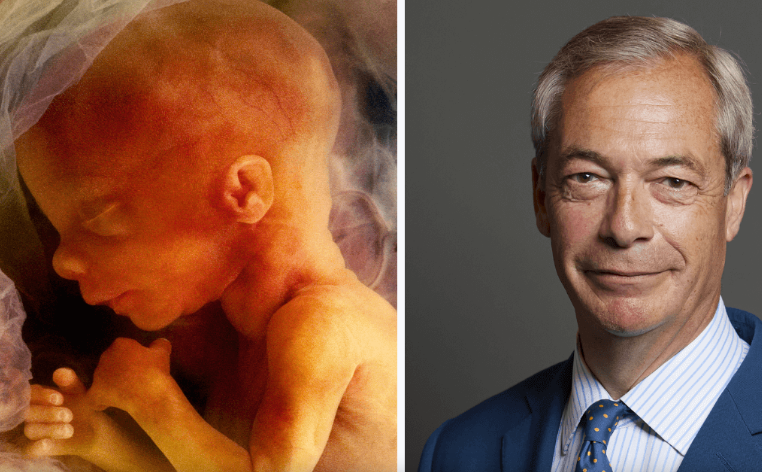
Reform UK leader and MP for Clacton, Nigel Farage, has branded the UK24-week abortion limit “utterly ludicrous”, “irrational” and “totally out of date”.
Speaking at a press conference on Tuesday, the Reform MP and party leader said “I think it’s ludicrous, utterly ludicrous that we can allow abortion up to 24 weeks. And yet, if a child is born prematurely at 22 weeks, your local hospital will move heaven and earth and probably succeed in that child surviving and going on and living a normal life”.
“So I believe there is an inconsistency in the law. I believe it is totally out of date”.
“I think our current situation on this is irrational”, Farage added.
A large majority of the British public support reducing the abortion time limit. Polling undertaken by leading pollster ComRes found that 60% of the general population and 70% of women support a reduction in the time limit to 20 weeks or below.
The same polling showed 60% of both Conservative and Labour voters supported a reduction in the time limit to 20 weeks or below. 65% of Liberal Democrat voters were in favour of a reduction in the abortion time limit to 20 weeks or below. Significantly, among those with children aged 18 or under in their household, 69% supported reducing the abortion limit to 20 weeks gestation or below.
Clear and informed evidence has also been presented by experts in the field showing the improved survival rates for babies born before the current abortion limit. Medical doctor, John Wyatt, who is Emeritus Professor of Neonatal Paediatrics, Ethics & Perinatology at University College London and who has worked as a neonatologist for almost 30 years, has presented evidence from the UK and across the world “that there has been a steady improvement in the chances of survival of babies born at 22 and 23 weeks gestation since the Abortion Act was last amended [in 1990]”.
Professor Wyatt supported the lowering of the abortion limit to 22 weeks, saying “[T]he current abortion time limit of 24 weeks is not consistent with survival figures for babies born at 22 and 23 weeks gestation, and with current clinical, neonatal and paediatric practice”.
Farage’s abortion law comments are “obviously correct”
Farage was supported in his comments by Dr Calum Miller, NHS doctor and research associate at the University of Oxford specialising in abortion policy, who remarked “He is obviously correct”. In a separate, strongly worded, post, Miller said “[Farage] knows that the current law allowing abortion up to 6 months is evil and barbaric, whether you’re pro-life or pro-choice”.
Farage’s reference to “an inconsistency in the law” is also supported by evidence from official abortion data. While the law permits ending the lives of babies at 22 and 23 weeks current medical practice also strives to save the lives of many babies born prematurely at 22 or 23 weeks gestation.
The annual abortion statistics for England and Wales in 2021 reveal that 755 abortions were performed under Section 1(1)(a) of the Abortion Act when the baby was at 22 or 23 weeks gestation (the vast majority of abortions are permitted under Section 1(1)(a) of the Abortion Act, for which there is currently a 24-week time limit). At the same time, according to a recent study, there were a total of 261 babies born alive at 22 and 23 weeks, before the abortion limit, who survived to discharge from hospital in 2020 and 2021.
A number of hospitals in England provide specialist care for extremely premature babies, usually those born before 27 weeks gestation, and also perform late-term abortions, between 20 and 23 weeks. According to statistics released by the Department of Health and Social Care, between 2018 and 2021 (2018, 2019, 2020, 2021), Birmingham Women’s Hospital performed 143 abortions where the baby was between 20 and 23 weeks gestation in 2021. At the same time, their neonatal intensive care unit “provides intensive care to premature babies born as early as 23 weeks”.
This inconsistency has also been highlighted by former Conservative MP, Caroline Ansell.
“In the decade to 2019 alone”, Ansell wrote, “the survival rate in the UK for extremely premature babies born at 23 weeks doubled, prompting new guidance from the British Association of Perinatal Medicine (BAPM) that enables doctors to intervene to save premature babies from 22 weeks gestation”.
The statistics above also highlight the inaccuracy of a statement made by The British Pregnancy Advisory Service (BPAS) in response to Farage’s comments, which said “[I}t is wrong to suggest that there is any medical evidence that supports a reduction in the abortion time limit”.
The UK already has an extreme abortion law – we don’t need to make it worse
Farage’s comment about the law being “irrational” is supported by the fact that the UK abortion law is already extreme, with its time limit double that of the most common abortion limit among European Union (EU) countries.
In most EU countries, abortion is only legal on demand or on broad social grounds up to 12 weeks gestation, making legislation in the United Kingdom double the average among EU countries.
When compared to almost every European Union country, it is clear that the United Kingdom is an outlier.
Among the 27 countries that are member states of the European Union, three have a time limit for abortion on demand or on broad social grounds at 10 weeks, one country at 11 weeks, 15 countries at 12 weeks, 3 countries at 14 weeks and two countries only allow abortion in very limited circumstances.
Countries with 12-week limits for abortion on demand or on broad social grounds include Germany, Italy and Belgium as well as the more “liberal” Nordic countries Denmark and Finland. Even Sweden has a time limit for abortion on demand or on broad social grounds that is much lower than the United Kingdom at 18 weeks.The last time the abortion limit was lowered in 1990, the improved survival rates for extremely prematurely born babies was one of the key considerations that motivated this change. By the same logic, and informed by the improved survival rates for babies born at 22 and 23 weeks gestation, the abortion time limit should also be lowered now.
Spokesperson for Right To Life UK, Catherine Robinson, said “It is significant that Nigel Farage, who calls himself pro-choice, can recognise the ludicrous and contradictory nature of the current abortion law”.
“Tonia Antoniazzi claims there is ‘no ethical basis’ for reducing the abortion time limit, but the very fact that an unborn baby’s life can be ended at 24 weeks gestation is itself an ethical basis for reducing the abortion limit.”.
“Currently, a baby at 22 or 23 weeks gestation could be born prematurely and have a dedicated medical team provide expert care to try to save his or her life, while another baby at the same age could have their life deliberately ended by abortion in the same hospital at the same time”.
“This is clearly inconsistent and a contradiction in law, a contradiction which must end. We echo Farage’s call for this issue to be debated in Parliament”.