

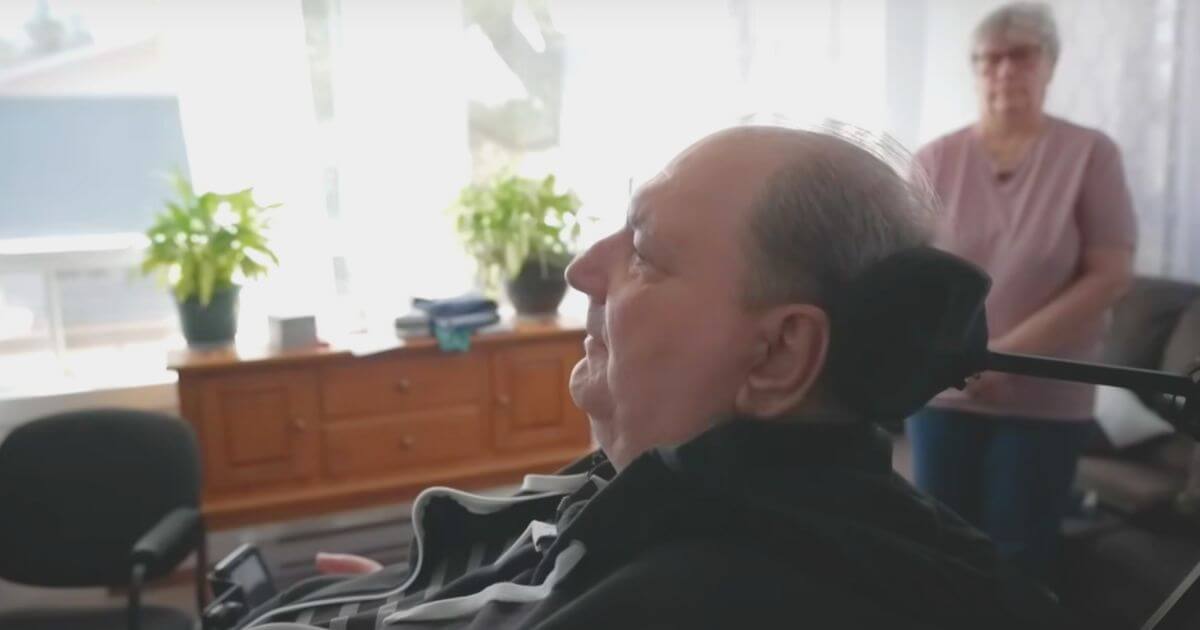
A woman in Canada has described the death of her husband, who died by euthanasia after developing severe pressure sores, as a “horror” as a public inquiry begins.
A coroner’s public inquiry has begun into the death of Normand Meunier, 66, who was quadriplegic and left on a stretcher in the Saint-Jérôme Hospital emergency room in Quebec in January of last year. He developed serious bedsores on his buttocks that left muscle and bone exposed because he did not have access to a special mattress, which would distribute weight evenly throughout his body. He subsequently opted to have his life ended by euthanasia under Canada’s ‘Medical Assistance in Dying’ programme.
The day before his death in March last year, Meunier told Radio Canada “I don’t want to be a burden. At any rate, the medical opinions say I won’t be a burden for long; as the old folks say, it’s better to kick the can”.
Meunier’s widow, Sylvie Brosseau, told reporters that “His last two weeks…it was horror”. She said “It was horrible. He had no buttocks. There was nothing left”. She described the system as “totally negligent”.
Brosseau highlighted a lack of communication between different parts of the healthcare system as a major factor in the failures of proper care that led to her husband’s decision to request an assisted suicide.
Meunier was told that the sore – a gaping hole a few centimetres in diameter – would take several months to heal. The day before his death, he told Radio Canada that he preferred to end his physical and psychological suffering by opting for state euthanasia.
The inquiry was demanded by Moëlle Épinière et Motricité Québec, an advocacy group for people with spinal cord injuries.
The group’s President, Walter Zelaya, told reporters that “There are deaths that happen that shouldn’t happen, because we have everything we need to treat these people”.
He added “We have the expertise, but often we lack the coordination. There’s negligence that happens”.
Zelaya also stated that bedsores are often not considered important, even by some healthcare professionals. “There’s a misunderstanding among key personnel. It’s important they understand a pressure sore can lead to death if it’s not treated properly”.
Normand Meunier’s final trip to the hospital was not the first time that he had struggled to access adequate care. After becoming quadriplegic in 2022, hospital visits became a regular occurrence.
In the months prior to his death in 2024, he had been hospitalised numerous times with infections.
“Each time, we had to ask for the special mattress which never arrived. It was a constant battle,” Munier’s wife said. “At the end, the head of the ER threatened to ban me from entering the hospital”.
Disability advocates in Canada have warned that Normand Meunier’s death highlights the reality of Medical Assistance in Dying (MAiD) providing an excuse for the inadequate provision of medical care.
“It is becoming an alternative to decent care, and the numbers will explode” said Steven Laperrière, general manager of Regroupement des Activistes Pour L’Inclusion au Québec (RAPLIQ), a group that offers support and advocacy in defending the rights of disabled people.